
 Industry News
Why Vacuum Furnaces are Essential for Biocompatible Medical Implants
Normantherm•7/5/2026
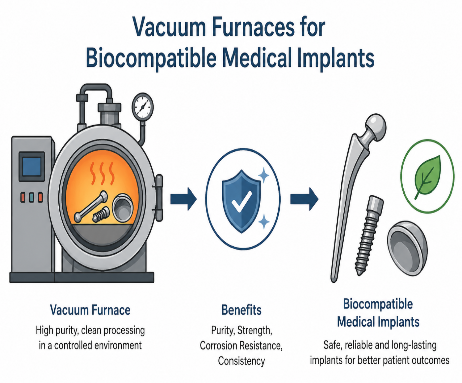
The manufacturing of life-critical medical implants—such as titanium orthopedic joints, cobalt-chrome bone screws, and nitinol cardiovascular stents—demands absolute material purity and structural integrity to guarantee biocompatibility inside the human body. Vacuum furnaces are indispensable in this process because they eliminate atmospheric gases like oxygen, nitrogen, and hydrogen from the heating chamber. At elevated temperatures, reactive implant metals act like sponges; exposure to even trace amounts of oxygen creates brittle oxide layers, while hydrogen absorption causes embrittlement, both of which can lead to catastrophic catastrophic fatigue failure post-implantation. Processing these components under high vacuum (often exceeding $10^{-5}\text{ mbar}$) ensures a completely bright, non-oxidized surface finish, eliminating the risk of interstitial contamination and preserving the metal’s inherent fatigue resistance and flexibility.
Beyond preventing contamination, vacuum heat treating plays a pivotal role in the precise metallurgical engineering required for medical devices. For instance, shape-memory alloys like Nitinol rely on tightly controlled vacuum annealing and rapid gas quenching to "program" their superelastic properties, ensuring a stent can reliably expand inside a coronary artery. Furthermore, because vacuum processing prevents the formation of scale or surface defects, it minimizes the need for aggressive chemical post-cleaning or acid pickling, maintaining strict dimensional tolerances on intricately machined porous coatings designed for biological bone ingrowth. By delivering unmatched temperature uniformity ($\pm 5^\circ\text{C}$ or better) and a perfectly inert environment, vacuum furnaces ensure that every medical implant meets the uncompromising safety and longevity standards mandated by global healthcare regulations.
You may also like
Industry News Industry News
 Industry News