
 Product News
Welding Electrodes to Silicon Carbide (SiC)
Normantherm•6/28/2026
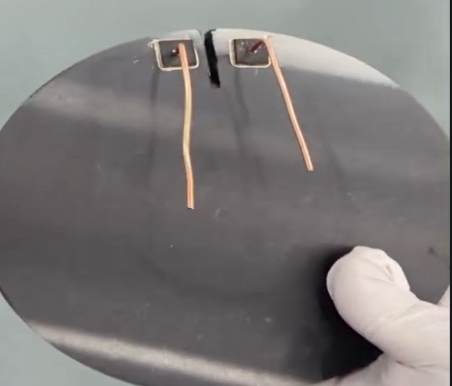
Connecting metal electrodes to a Silicon Carbide (SiC) component—such as the disc assembly shown in Screenshot 2026-06-27 212703.jpg—presents a unique engineering challenge because metals do not naturally bond well to advanced covalent ceramics. To overcome this, the SiC surface must first undergo a localized metallization process, where a specialized thin film is deposited and annealed at high temperatures to form a conductive silicide contact pad (the square bases visible on the disc). Heavy-duty wire leads are then attached to these custom pads using ultrasonic wire bonding or micro-resistance welding.
Because SiC is a highly rigid, brittle material subject to extreme thermal environments, the design incorporates a distinct stress-relief slot cut between the two terminals to prevent the ceramic from cracking under thermal expansion. These robust, welded electrode assemblies are critical for delivering reliable power in demanding, high-temperature applications like semiconductor processing equipment and power electronics.
You may also like
Product News Product News
 Product News