
 Product News
Vacuum Heat Treatment of 316L Stainless Steel Bipolar Plates for Hydrogen Fuel Cells
Normantherm•9/9/2026
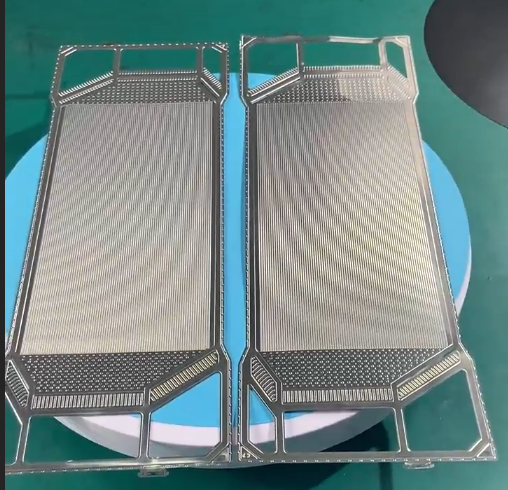
316L stainless steel bipolar plates are important components in hydrogen fuel cell systems. They provide electrical conduction between individual cells, support the flow of reactants and cooling media, and help maintain the structural integrity of the fuel cell stack.
Because bipolar plates are typically thin and contain precisely formed flow channels, controlling residual stress and dimensional deformation during manufacturing is critical. Vacuum heat leveling and vacuum annealing can be used as controlled thermal processing methods to improve dimensional stability and relieve internal stresses in 316L stainless steel bipolar plates.
For manufacturers of hydrogen fuel cell components, selecting an appropriate vacuum heat treatment furnace is therefore an important part of the production process.
What Are 316L Stainless Steel Bipolar Plates?
A bipolar plate is a core component in a proton exchange membrane fuel cell and other fuel cell architectures. It separates adjacent cells while providing pathways for hydrogen, air or oxygen, and cooling media.
316L stainless steel is attractive for certain bipolar plate applications because of its corrosion resistance, mechanical properties, and suitability for precision manufacturing. However, forming thin stainless steel plates into complex flow-field geometries can introduce residual stresses and dimensional distortion.
The resulting stress can affect the flatness and dimensional accuracy of the finished bipolar plate. Thermal processing can therefore play an important role in stabilizing the component after forming.
Why Vacuum Heat Treatment Is Used for Fuel Cell Bipolar Plates
Fuel cell bipolar plates require controlled geometry because the flow-field channels must interact correctly with the membrane electrode assembly and other stack components.
During manufacturing, forming, stamping, machining, or other processes can introduce residual stresses into 316L stainless steel. If these stresses are not adequately controlled, subsequent handling or thermal exposure may cause dimensional changes.
Vacuum annealing for stress relief provides a controlled method of reducing these internal stresses. Processing in a vacuum environment also helps minimize oxidation and unwanted surface contamination compared with conventional atmospheric heating.
For thin stainless steel bipolar plates, controlled heating and cooling are particularly important because excessive thermal gradients can contribute to distortion.
Vacuum Heat Leveling of 316L Bipolar Plates
Vacuum heat leveling can be used to help improve the dimensional condition of precision stainless steel components. The objective is to achieve more stable and uniform plate geometry through controlled thermal processing.
For bipolar plates, maintaining flatness is important because these components are assembled into stacks with multiple layers. Even relatively small dimensional variations can influence assembly quality and contact conditions.
The specific heat-leveling procedure depends on the plate geometry, material condition, thickness, forming history, required flatness, and production requirements. Furnace temperature, heating rate, holding time, vacuum level, loading method, and cooling conditions should therefore be developed according to the actual component.
Vacuum Annealing for Stress Relief
Vacuum annealing is a heat treatment process used to reduce residual stresses and improve the stability of metallic components.
For 316L stainless steel bipolar plates, stress relief can be particularly valuable after forming operations that create complex flow channels. A controlled annealing cycle allows the material to undergo thermal relaxation while reducing the risk of oxidation during treatment.
The final process parameters should be established through material specifications and process trials rather than applying a single temperature or holding time to every bipolar plate design.
Key Benefits of Vacuum Treatment for Bipolar Plates
Vacuum heat treatment can provide several manufacturing advantages for 316L stainless steel bipolar plates:
- Residual stress reduction: Helps relieve stresses introduced during forming and fabrication.
- Improved dimensional stability: Supports more consistent flatness and geometry.
- Reduced oxidation: Vacuum processing minimizes direct exposure to atmospheric oxygen during heating.
- Controlled thermal processing: Precise furnace control supports repeatable production.
- Surface cleanliness: A controlled vacuum atmosphere can help maintain a cleaner surface condition.
The actual result depends on the stainless steel grade and condition, plate geometry, forming process, furnace configuration, and heat-treatment parameters.
Role of Bipolar Plates in Hydrogen Fuel Cells
In a hydrogen fuel cell, bipolar plates perform several functions simultaneously. They help distribute reactant gases through flow channels, conduct electrical current between cells, and can provide pathways for thermal management.
This combination of electrical, mechanical, thermal, and chemical requirements makes bipolar plate manufacturing a demanding precision process.
For stainless steel bipolar plates, surface condition and dimensional accuracy are particularly important. Heat treatment must therefore be integrated into the overall manufacturing process rather than treated as an isolated operation.
Importance of Furnace Uniformity and Control
A suitable vacuum annealing furnace should provide stable temperature control and appropriate temperature uniformity across the working zone.
This becomes increasingly important when processing thin bipolar plates in batches. Uneven thermal exposure can produce inconsistent stress-relief results or contribute to dimensional variation.
Furnace selection should consider:
- Bipolar plate dimensions and thickness
- Batch quantity and loading arrangement
- Required operating temperature
- Vacuum requirements
- Temperature uniformity
- Heating and cooling control
- Required production throughput
Proper loading is also important because thin plates can be sensitive to mechanical support and thermal conditions during processing.
Normantherm Vacuum Furnace Solutions
Normantherm provides vacuum furnace systems for heat treatment, annealing, stress relief, and other controlled thermal processing applications. Its industrial furnace solutions are designed for precision processing of materials including stainless steel and other engineering alloys.
For manufacturers working with 316L stainless steel bipolar plates, vacuum furnace technology can be integrated into a production process aimed at controlling residual stress, dimensional stability, and surface condition.
Explore Normantherm Vacuum Furnace Solutions
The appropriate furnace configuration depends on bipolar plate dimensions, batch size, production volume, required thermal cycle, and the desired degree of process control.
Conclusion
316L stainless steel bipolar plates for hydrogen fuel cells require precise manufacturing and thermal processing to achieve the dimensional stability needed for fuel cell stack assembly. Vacuum heat leveling and vacuum annealing for stress relief provide controlled approaches for reducing residual stress and supporting consistent plate geometry.
As hydrogen fuel cell technology continues to develop, reliable thermal processing will remain an important part of manufacturing precision metallic bipolar plates. A properly designed vacuum heat treatment furnace can help manufacturers establish repeatable and controlled processing for 316L stainless steel fuel cell components.
You may also like
Product News Product News
 Product News