
 Product News
Brazing of Stainless Steel Pneumatic Pipes for Precision Instruments
Normantherm•9/13/2026
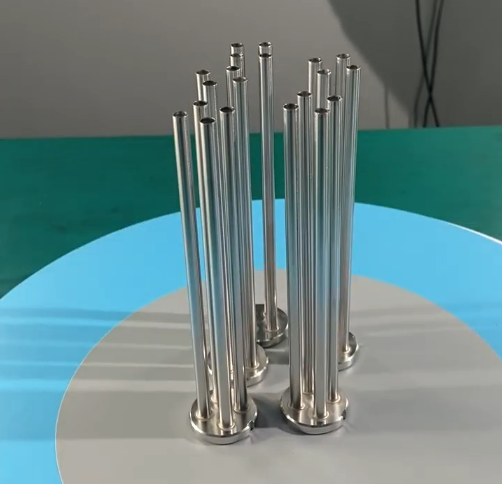
Stainless steel pneumatic pipes are widely used in precision instruments and industrial systems where controlled gas or air delivery is required. Because these assemblies often contain small-diameter tubing, multiple connections, and precisely positioned components, the joining process must provide consistency without compromising dimensional accuracy or surface condition.
Vacuum brazing of stainless steel pneumatic pipes offers a controlled method for joining pipe assemblies and precision components. By processing the parts inside a vacuum furnace, manufacturers can reduce exposure to atmospheric oxygen during heating and achieve a clean, repeatable thermal cycle.
Why Braze Stainless Steel Pneumatic Pipes?
Pneumatic pipe assemblies used in precision instruments must maintain reliable connections under their intended operating conditions. The joint needs to be properly formed while preserving the geometry of the tubing and connected components.
Traditional mechanical joining methods may not always be suitable for compact or complex assemblies. Brazing allows a filler metal to flow into the prepared joint through capillary action, creating a joined assembly without melting the primary stainless steel components.
For precision pneumatic assemblies, the brazing process can be selected according to the stainless steel grade, pipe dimensions, joint clearance, filler metal, operating environment, and required mechanical or sealing performance.
Advantages of Vacuum Brazing for Stainless Steel Pipes
Vacuum brazing is particularly useful when stainless steel components require a controlled and relatively clean joining environment.
During vacuum brazing, atmospheric gases are removed from the furnace before the assembly is heated. This helps limit oxidation during the thermal cycle and can reduce the need for extensive post-brazing cleaning.
Controlled furnace heating is also important for small pneumatic pipes because excessive or uneven heating can affect component geometry and joint consistency.
Key advantages include:
- Reduced oxidation during brazing
- Controlled heating and cooling
- Clean processing environment
- Repeatable brazing cycles
- Suitable for complex stainless steel assemblies
- Reduced requirement for post-process surface cleaning
The final joint quality depends on proper component preparation, joint design, filler selection, furnace parameters, and inspection procedures.
Vacuum Brazing Process for Pneumatic Pipe Assemblies
The process starts with preparing the stainless steel pipes and components. Surfaces must be properly cleaned to remove oil, grease, dirt, and other contaminants that could interfere with filler-metal flow.
The pipe components are then positioned according to the required assembly geometry. Proper joint clearance is important because brazing relies on capillary action to distribute the molten filler metal through the joint.
An appropriate brazing filler is selected according to the stainless steel material and the service requirements of the precision instrument. The exact filler alloy and thermal cycle should be established based on the application rather than using a universal brazing parameter.
The prepared assembly is placed into the vacuum brazing furnace. After evacuation, the furnace heats the components according to the defined thermal profile.
As the filler reaches its melting range, it flows into the prepared joints and forms the brazed connection. The assembly is then cooled under controlled conditions before being removed from the furnace.
After brazing, the components can undergo visual inspection, dimensional inspection, pressure or leak testing, and other application-specific quality checks.
Importance of Joint Design and Cleanliness
Stainless steel pneumatic pipes used in precision instruments often have relatively small joints. This makes surface preparation and joint clearance especially important.
Contamination can interfere with filler-metal wetting and flow, while an unsuitable joint gap can lead to incomplete filler distribution or inconsistent joints.
Correct positioning is also important because thin tubes can be susceptible to movement or distortion during heating. Fixtures and furnace loading methods should therefore be selected according to the geometry of the assembly.
Applications in Precision Instrumentation
Brazed stainless steel pneumatic tubing can be used in equipment where controlled gas or air flow is required. Potential applications include analytical instruments, laboratory equipment, industrial measurement systems, automation equipment, and specialized pneumatic assemblies.
The exact application depends on the design and operating requirements of the instrument. In systems involving sensitive gases or controlled pressure, cleanliness and joint integrity become particularly important considerations.
Why Temperature Uniformity Matters
Temperature uniformity is a critical consideration when brazing stainless steel pneumatic pipes. The filler metal must reach its required melting range while the complete assembly receives sufficiently consistent thermal exposure.
A temperature difference across the furnace load can result in variations in filler flow and joint formation. For precision components, uncontrolled thermal gradients may also contribute to dimensional changes.
A suitable vacuum brazing furnace should therefore provide appropriate temperature control, thermal uniformity, vacuum performance, and a heating zone matched to the size of the components being processed.
Normantherm Vacuum Brazing Furnace Solutions
Normantherm develops vacuum furnace systems for industrial brazing and heat treatment applications. Its equipment can be used for stainless steel components, precision assemblies, tooling, cooling components, and other engineered parts requiring controlled thermal processing.
For stainless steel pneumatic pipe assemblies, furnace selection should consider the component dimensions, batch quantity, material grade, joint configuration, required brazing temperature, vacuum requirements, and production volume.
Explore Normantherm Vacuum Furnace Solutions
Conclusion
Brazing stainless steel pneumatic pipes for precision instruments requires careful control of joint design, surface preparation, filler-metal selection, temperature, and atmosphere. Vacuum brazing provides a controlled thermal environment that can help reduce oxidation and support consistent joining of precision stainless steel assemblies.
For manufacturers producing pneumatic tubing, instrument components, and other compact stainless steel assemblies, a properly configured vacuum brazing furnace can provide a repeatable production process while supporting the cleanliness and dimensional requirements of precision applications. Normantherm provides vacuum brazing and heat treatment furnace solutions for a wide range of stainless steel and precision industrial components.
You may also like
Product News Product News
 Product News