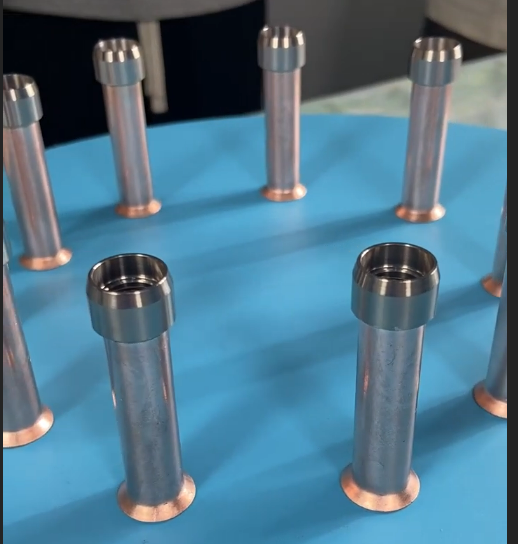
In aerospace systems, weight reduction and thermal efficiency are critical. Titanium alloys offer exceptional strength-to-weight ratio, while copper provides superior heat conduction. However, directly welding these two materials is challenging due to their dissimilar melting points and metallurgical properties.
Normantherm solves this challenge with precision vacuum brazing. Our controlled furnace environment enables:
Oxidation-free bonding without flux contamination
Uniform wetting of titanium and copper surfaces
Stable and repeatable thermal joint properties
This process allows aerospace manufacturers to produce:
Heat exchangers and cooling channels
Hybrid structural components
Lightweight thermal modules for avionics and propulsion systems
By ensuring clean, high-strength Ti-Cu interfaces, Normantherm supports the next generation of efficient, lightweight aerospace assemblies.
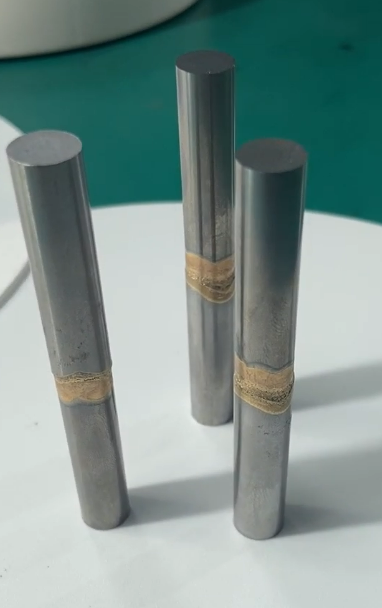
The components shown above are H13 tool steel and tungsten carbide assemblies processed in a Normantherm vacuum brazing furnace. This material combination is commonly used in punching tools, wear parts, forming dies, and cutting applications where both toughness and wear resistance are required.
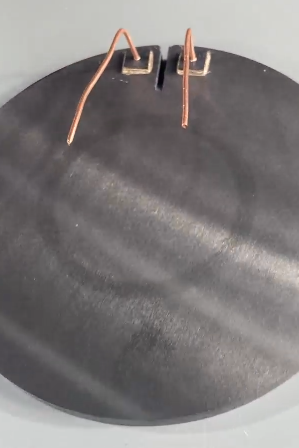
A silicon carbide heating plate is built for extreme temperatures. But the electrode connection is often the weakest link. Poor welding creates resistance heat buildup and premature failure.
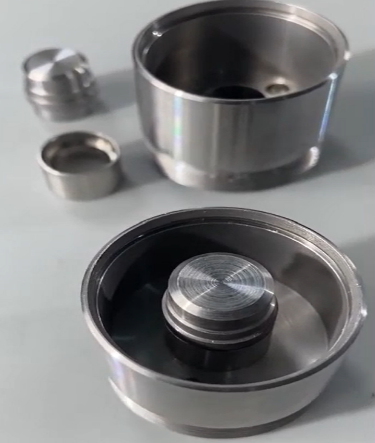
Vacuum brazing of carbon steel with stainless steel is an advanced joining process widely used in industrial, automotive, aerospace, and precision engineering applications where high-strength and leak-free assemblies are required.