
Vacuum Brazed Copper Components
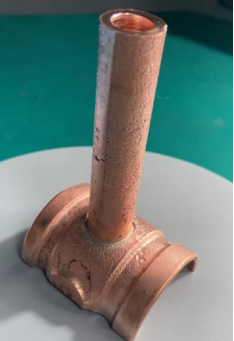
The sample component shown above demonstrates a typical vacuum brazed copper assembly consisting of a tubular section joined to a formed copper base. Such joints demand excellent metallurgical bonding without oxidation, distortion, or contamination.
Unlike conventional flame brazing, vacuum brazing is carried out inside a controlled high-vacuum environment where oxygen and atmospheric contamination are eliminated. This offers several important advantages for copper components:
1. Oxide-free, clean brazed joints
2. Excellent capillary flow of filler metal
3. Strong and leak-tight assemblies
4. Uniform heating throughout the component
5. Minimal discoloration and post-cleaning requirement
6. Improved repeatability for batch production
For copper assemblies used in thermal and pressure applications, these factors directly influence product performance and service life.
Critical Process Considerations
Copper has very high thermal conductivity, which makes precise temperature control extremely important during brazing. Uniform heat distribution inside the vacuum furnace ensures proper filler metal flow across the joint area without localized overheating.
Key process parameters generally include:
1. Controlled heating and soaking profile
2. Proper joint clearance for capillary action
3. Selection of suitable copper or silver-based filler alloys
4. High vacuum levels to prevent oxidation
5. Controlled cooling to minimize thermal stresses
In many applications, vacuum levels in the range of 10⁻⁴ to 10⁻⁵ mbar are maintained to achieve clean and high-quality brazed joints.
At Normantherm, our vacuum brazing furnaces are designed to deliver precise temperature uniformity, stable vacuum performance, and reliable process repeatability for copper and copper-alloy components. From small precision assemblies to production-scale thermal components, our systems support high-quality brazing with consistent metallurgical results.