
Finished Copper Water-Cooled Plates Manufactured Through Vacuum Brazing Technology
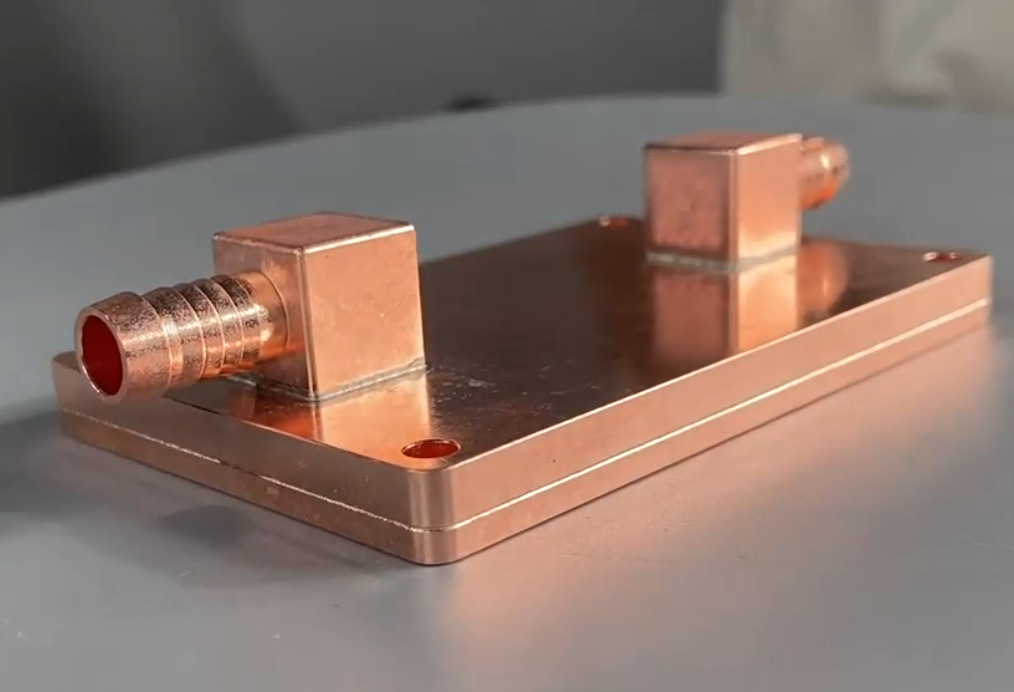
Efficient thermal management has become essential in modern industrial systems, especially in applications involving high-power electronics, semiconductor equipment, and industrial automation. Copper water-cooled plates are critical components used to dissipate heat and maintain stable operating temperatures.
To achieve high reliability and leak-proof performance, manufacturers increasingly rely on vacuum brazing technology to produce precision copper cooling plates.
Why Copper Is Used in Water-Cooled Plates
Copper is one of the most effective materials for thermal management applications.
Its key advantages include:
- Exceptional thermal conductivity
- Efficient heat dissipation capability
- Excellent machinability for complex cooling channels
- Reliable mechanical strength
- Long-term operational stability
These properties make copper ideal for cooling systems used in advanced industrial applications.
Manufacturing Challenges of Copper Cooling Plates
Copper water-cooled plates often contain intricate internal channel structures designed for coolant circulation. Producing these components requires highly reliable joining methods.
Manufacturers must address challenges such as:
- Preventing oxidation during high-temperature processing
- Achieving leak-proof internal channels
- Maintaining dimensional precision
- Ensuring uniform bonding across large surfaces
Traditional welding techniques may introduce contamination or uneven joints that affect cooling performance.
Advantages of Vacuum Brazing for Copper Cooling Plates
Vacuum brazing provides a controlled, oxygen-free environment that ensures clean and reliable joining of copper components.
Key advantages include:
- Oxidation-Free Processing
The vacuum environment prevents oxidation and preserves copper’s thermal conductivity.
- Strong Metallurgical Bonding
Uniform filler metal flow creates durable and stable joints.
- Leak-Proof Internal Channels
Vacuum brazing ensures secure sealing of cooling pathways for reliable fluid circulation.
- High Production Consistency
Precise temperature control and uniform heating improve repeatability and product quality.
These benefits make vacuum brazing the preferred manufacturing process for high-performance cooling plates.
Performance Benefits of Finished Water-Cooled Plates
Finished vacuum-brazed copper water-cooled plates offer several important performance advantages:
- Efficient thermal transfer and cooling performance
- Reliable leak-proof operation under pressure
- High structural integrity and durability
- Stable long-term performance in continuous operation
- Reduced maintenance requirements
These features are essential for modern thermal management systems.
Applications in India’s Industrial and Electronics Industries
In India, copper water-cooled plates are increasingly used in:
- Power electronics and IGBT modules
- Semiconductor manufacturing systems
- Data center liquid cooling infrastructure
- Laser and photonics equipment
- Industrial automation and control systems
As industries continue adopting high-power and high-density systems, demand for advanced cooling technologies continues to grow.
Normantherm Vacuum Brazing Solutions
At Normantherm, advanced vacuum brazing furnaces are designed for precision thermal management applications and copper brazing processes.
Our systems provide:
- High-vacuum, contamination-free environments
- Precise temperature control and uniform heating
- Reliable brazing of complex cooling structures
- Consistent and repeatable production quality
These capabilities enable manufacturers to produce high-performance copper cooling plates with confidence.
Conclusion
Finished copper water-cooled plates produced through vacuum brazing technology provide reliable thermal management, leak-proof operation, and long-term durability for advanced industrial systems.
With advanced furnace technology and proven manufacturing expertise, Normantherm continues to support modern industries with high-quality vacuum brazing solutions for thermal management applications.